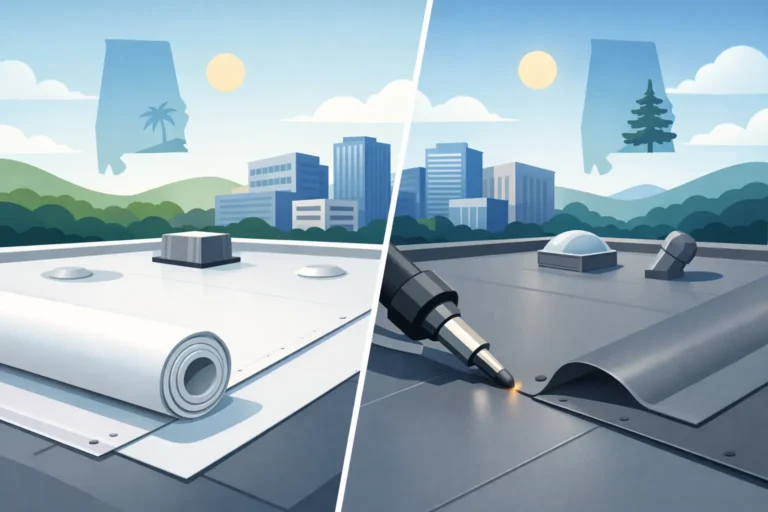
A low-slope commercial roof has to do more than keep rain out. It must handle Alabama heat, standing water after heavy storms, rooftop traffic, and the condition of the building beneath it. When comparing TPO vs PVC roofing, the right choice often comes down to how the property is used, what sits inside it, and how much long-term protection the owner needs.
Both systems are single-ply membranes commonly installed on commercial buildings. Both can provide a clean, reflective surface that helps manage heat gain. But they are not identical materials, and the details matter when you are protecting a retail center, office, warehouse, restaurant, apartment building, or other commercial property.
TPO vs PVC Roofing: The Main Difference
TPO stands for thermoplastic polyolefin. PVC stands for polyvinyl chloride. Both membranes are installed in wide sheets, with seams that are heat-welded together to create a continuous water-shedding surface. This welded-seam design is one reason single-ply roofing is a popular option for low-slope buildings.
The biggest practical difference is chemical resistance. PVC roofing is generally the stronger choice where oils, grease, animal fats, and harsh chemicals may contact the roof. That makes it especially useful for restaurants, food-processing facilities, and buildings with grease exhaust systems.
TPO is often selected for its balance of performance and cost. It is widely used on offices, warehouses, medical buildings, retail properties, and other roofs that need reliable weather protection without the added chemical-resistance requirements of PVC.
When TPO Roofing Makes Sense
TPO is a practical commercial roofing system for many Alabama properties. Its light-colored surface reflects sunlight, which can reduce heat absorbed by the roof compared with darker materials. In a hot climate, that can support a more comfortable building and ease the workload on HVAC equipment, although actual energy savings depend on insulation, roof design, building use, and other factors.
A properly installed TPO system offers strong seams, flexibility, and good resistance to normal weather exposure. It is a common choice for large roof areas because it can deliver dependable coverage at a competitive price point. For a warehouse, office, church, or general retail building, TPO may offer the value an owner is looking for.
TPO is not automatically the lowest-cost solution in every situation. Membrane thickness, insulation needs, roof tear-off, drainage corrections, flashing work, and access challenges all affect the final project cost. A low bid that skips needed preparation can become expensive later if leaks develop around penetrations, walls, drains, or edge details.
When PVC Roofing Is Worth the Investment
PVC roofing is also highly reflective and heat-welded at the seams, but it is often chosen for demanding environments. Its ability to resist grease and chemical exposure is the reason many restaurant owners and food-service facilities prefer it.
Grease discharged from kitchen exhaust systems can damage certain roofing materials over time. If the roof sits below exhaust fans or grease vents, selecting a membrane built to handle that exposure is not an upgrade for appearance – it is a protection decision. PVC can also be a sound choice for buildings where chemical fumes, oils, or other industrial contaminants are a regular concern.
PVC usually carries a higher material cost than TPO. That higher upfront investment may be justified when the roof faces conditions that could shorten the life of a less resistant membrane. For a standard office building with no grease-producing operations, however, the added cost may not provide enough practical benefit to make PVC the better fit.
Cost Depends on More Than the Membrane
Property owners often ask whether TPO or PVC costs less. In many projects, TPO is the more budget-friendly option, while PVC costs more because of its specialized performance characteristics. Still, membrane price is only one part of the roofing system.
The condition of the existing roof deck and insulation matters just as much. Wet insulation may need to be removed. Poor drainage may require tapered insulation or other corrections. A roof with numerous HVAC units, skylights, drains, pipes, parapet walls, and equipment curbs requires more detailed flashing work than a wide-open roof.
The useful comparison is not simply the cost per square foot. It is the expected cost of ownership over the life of the roof. A system that matches the building’s exposure, is installed correctly, and receives regular maintenance can help prevent emergency repairs, interior damage, and business interruptions.
Alabama Weather Raises the Stakes
Commercial roofs in Tuscaloosa, Birmingham, and surrounding communities face intense sun, humidity, heavy rain, wind events, and hail. A single-ply membrane can perform well in these conditions, but the installation details determine whether it holds up when weather turns severe.
Fastening patterns, perimeter securement, seam welding, flashing around penetrations, and drainage all deserve close attention. Wind uplift pressure is often strongest around roof edges and corners. If those areas are not designed and installed correctly, a storm can turn a small weakness into a major loss.
Ponding water is another issue that should not be ignored. Neither TPO nor PVC should be expected to solve drainage problems by itself. Water that remains on a roof long after rainfall can expose weak seams, clogged drains, deteriorated flashing, and insulation issues. Before a replacement, the roof should be inspected for the cause of standing water, not just covered with a new membrane.
Installation Quality Matters as Much as Material Choice
A TPO or PVC roof is a complete system, not just a white sheet on top of a building. The substrate must be prepared, insulation must be secure, seams must be welded properly, and every transition must be detailed for water and wind resistance.
Poor seam welds may not be obvious from the ground. Inconsistent welding, poorly flashed penetrations, open termination details, or unsecured edge metal can create leak paths that only show up after a hard rain. That is why commercial property owners should choose a contractor based on system knowledge and workmanship, not price alone.
Bluefin Exteriors helps property owners evaluate commercial roofing conditions with a straightforward inspection process. The goal is to identify the condition of the membrane, seams, drains, flashing, insulation, and storm-related damage before recommending repair, restoration, or replacement.
Storm Damage and Insurance Considerations
After hail or high winds, a commercial roof may have damage that is difficult to identify without a close inspection. Punctures, displaced flashing, compromised seams, and impact damage can allow water into the assembly even when the roof does not appear severely damaged from the ground.
If storm damage is suspected, document the date of the event, visible interior leaks, damaged rooftop components, and any temporary repairs. A professional inspection can provide the condition information needed to make an informed decision and support a claim when coverage applies. Insurance approval is never guaranteed, and the policy language controls coverage, but clear documentation can reduce confusion during the process.
It is also wise to address active leaks quickly. Waiting for a claim decision before making necessary temporary repairs can allow moisture to spread into insulation, decking, ceilings, inventory, or electrical systems.
How to Choose Between TPO and PVC
Start with the building’s use. A restaurant, commercial kitchen, or food-related facility should strongly consider PVC because grease exposure can be a deciding factor. A general office, warehouse, retail property, or multifamily building may find that TPO delivers the right combination of weather protection, reflectivity, and cost.
Then consider the roof itself. The best membrane will not compensate for saturated insulation, poor drainage, deteriorated decking, or improperly designed flashing. An inspection should determine whether the project needs a repair, a recover system over an existing roof, or a full tear-off and replacement.
Finally, consider the ownership plan. If the property will be held for years, a system designed for the building’s actual conditions is usually the better business decision. If the roof has a history of leaks or storm issues, detailed documentation and quality installation deserve more attention than a quick material comparison.
Before selecting a membrane, have the roof inspected while weather conditions and existing damage can still be evaluated clearly. A no-pressure assessment can give you a practical scope of work, help identify storm concerns, and make the next decision easier to make with confidence.
