
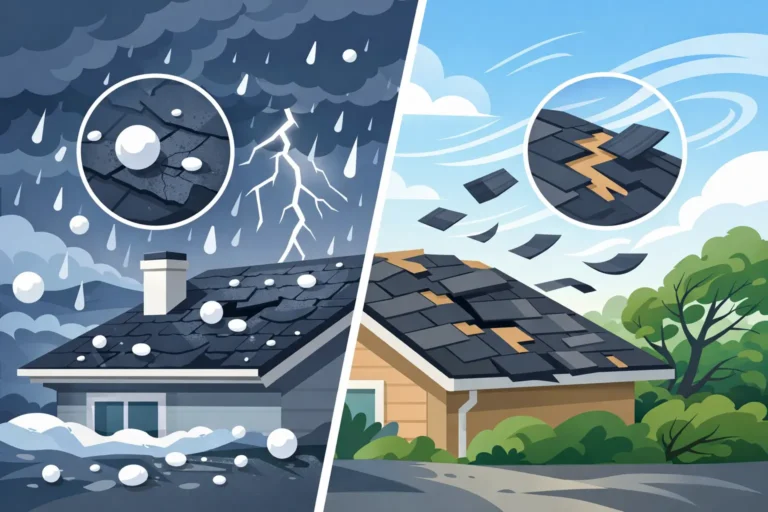
The morning after a strong Alabama storm, a lot of roofs look fine from the driveway. That is what makes hail vs wind roof damage so tricky. The damage is often subtle at first, but the difference matters because it affects how your roof performs, how your claim is documented, and whether a repair is enough or a full replacement makes more sense.
For homeowners and property owners in Tuscaloosa, Birmingham, and nearby communities, the goal is not to become a roofing expert overnight. It is to know what storm damage tends to look like, what not to guess at from the ground, and when to get a professional inspection before small issues turn into leaks, interior damage, or claim problems.
Why hail and wind damage are often confused
Hail and wind usually show up in the same storm, which is one reason they get mixed together. A roof can take direct impact from hail while also losing shingles or having seals broken by strong gusts. By the time a property owner notices a problem, the visible signs may overlap.
There is also a timing issue. Wind damage can be dramatic and easy to spot right away if shingles are missing or lifted. Hail damage is often less obvious. A roof may still look intact from the yard, even though the shingle surface has been bruised and its lifespan has been shortened.
That is why a quick visual check is useful, but it is not the same as a real inspection. Good documentation matters, especially if an insurance claim may be involved.
Hail vs wind roof damage: the main differences
The easiest way to think about hail damage is impact. The easiest way to think about wind damage is movement.
Hail damage happens when ice strikes the roof surface with enough force to dent, bruise, or dislodge the protective granules on shingles. On asphalt roofs, this can leave scattered impact marks that may feel soft or look darker where granules have been knocked away. On metal roofing, hail may leave visible dents. On commercial systems, the signs depend on the material, but impact marks and puncture concerns are the big issue.
Wind damage is different. Wind gets under roofing materials and tests the roof’s attachment points. It can crease shingles, lift their edges, break adhesive seals, pull ridge caps loose, and in stronger events remove shingles entirely. Sometimes the damage appears in a pattern along roof edges, ridges, or slopes that took the worst gusts.
Both forms of damage can compromise the roof, but they do it in different ways. Hail tends to weaken the surface and expose the roof to faster aging. Wind tends to loosen or remove materials, which can create more immediate water entry points.
What hail damage usually looks like
On asphalt shingles, hail damage often shows up as circular or random impact spots where granules are missing. Those spots may look darker than the surrounding shingle. In some cases, the asphalt mat underneath has been bruised. The spot can feel soft to the touch, but that is something best checked by a trained roofer during an inspection, not by a homeowner walking the roof.
You might also see signs away from the roof itself. Dented gutters, downspouts, metal vents, flashing, window screens, and soft metals around the property can support the story that hail hit the structure. Those details can be helpful when documenting a claim because they provide context for what the roof may have experienced.
Not every mark is hail, though. Blistering, age-related wear, foot traffic, and manufacturing irregularities can all be mistaken for storm damage. That is where experience matters. A proper inspection looks at the size, pattern, and consistency of the marks instead of assuming every imperfection came from the last storm.
Hail damage on different roofing materials
Metal roofs may show dents more clearly than shingles, but that does not always mean the roof needs replacement. Cosmetic dents and functional damage are not always the same thing. If seams, fasteners, panels, or coatings have been compromised, that becomes a more serious issue.
On flat and low-slope commercial systems like TPO, PVC, or EPDM, impact damage can be harder to spot without trained eyes. Surface marks may not tell the full story. The concern is whether the membrane, seams, or underlying insulation were affected.
What wind damage usually looks like
Wind damage often leaves clearer signs. Missing shingles are the obvious one, but they are not the only one. A shingle may still be in place and still be damaged if it has been lifted, creased, or unsealed.
A common sign is a horizontal crease across a shingle tab where the wind bent it back. Once that happens, the shingle may no longer seal properly. It might sit flat for now, but it is more vulnerable in the next storm. You may also notice shingles that appear out of line, corners that are lifted, exposed nail heads, or ridge cap pieces that have loosened.
Wind can also affect flashing around chimneys, walls, and roof penetrations. If those areas pull loose, water can get in even if the main field of shingles looks mostly intact.
Why wind damage can spread over time
One lifted shingle does not always stay one lifted shingle. Once the seal is broken, future wind has an easier time getting underneath nearby materials. That is why prompt inspection matters. What starts as a limited repair can turn into a larger section loss if it is ignored.
What insurance companies typically look for
Insurance carriers usually want evidence of storm-related damage, not just an aging roof that now has problems. That means the distinction between hail vs wind roof damage is not just technical. It can shape how the claim is evaluated.
For hail claims, adjusters often look for clear impact evidence on the roof and related metal components. For wind claims, they look for creased, lifted, or missing materials and signs that the damage came from a wind event rather than installation issues or long-term wear.
Documentation helps. Date-stamped photos, notes about the storm date, and a professional inspection can all support the process. Just as important, an honest inspection can also tell you when damage is minor, repairable, or unrelated to the storm. That protects you from filing a weak claim and wasting time.
This is where a contractor with insurance-claim experience can make the process less stressful. Bluefin Exteriors works with property owners who need clear damage documentation and practical guidance, not pressure.
When a repair may work and when replacement is smarter
It depends on the extent of the damage, the age of the roof, the roofing material, and whether matching materials are available. A few wind-damaged shingles on a newer roof may be a straightforward repair. Scattered hail damage on an older roof with brittle shingles can be more complicated, especially if the damage affects multiple slopes or shortens the roof’s remaining life.
The same is true for commercial roofing. A localized repair may be enough if the membrane and insulation are still sound. If storm damage is widespread, patching can become a short-term fix that leaves the building owner dealing with recurring problems later.
A trustworthy inspection should explain the trade-offs plainly. Sometimes the lowest upfront option is not the best long-term value. Other times a targeted repair is exactly the right call.
What you should do after a storm
Start from the ground. Look for obvious signs like missing shingles, displaced ridge caps, dented gutters, granules collecting in downspouts, or debris impact around the property. Take photos if you notice anything unusual, but do not climb onto the roof yourself.
Then schedule a professional roof inspection, especially if your area had hail reports, strong winds, or visible property damage nearby. The sooner damage is documented, the easier it is to understand your options and avoid preventable interior issues.
A no-pressure inspection should give you a clear answer on three points: whether storm damage is present, whether repair or replacement is recommended, and whether an insurance claim appears justified. That kind of clarity is what most property owners need after a storm.
If you are unsure whether your roof took hail, wind, or both, that is normal. What matters is getting an experienced set of eyes on it before the next round of weather tests a roof that has already been weakened.
