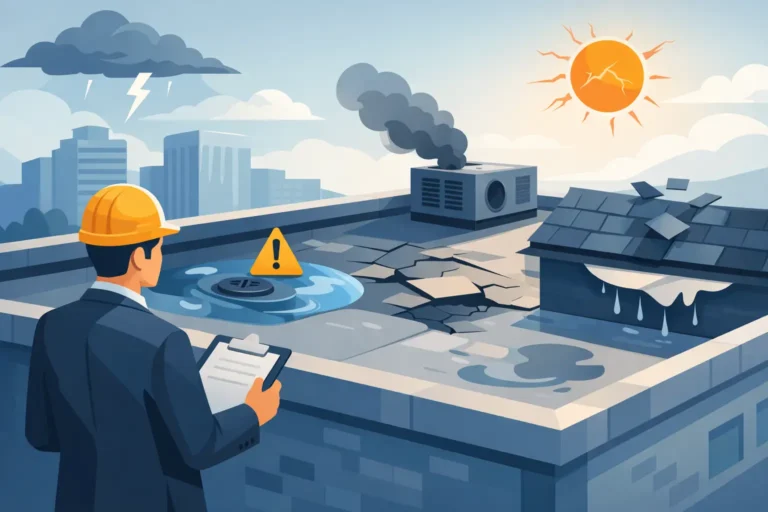
A commercial roof rarely fails all at once. More often, it gives building owners a series of warnings: a ceiling stain after heavy rain, water collecting near a drain, a loose membrane seam, or utility costs that keep creeping up. Knowing the top signs of commercial roof failure can help you address a manageable repair before it becomes interior damage, business disruption, mold concerns, or a costly replacement.
For property owners and facility managers in Tuscaloosa, Birmingham, and surrounding Alabama communities, timing matters. Our heat, humidity, heavy rain, hail, and high winds can expose weak points quickly, especially on flat and low-slope roofing systems. A professional inspection provides clarity without guesswork and gives you documentation if storm damage may support an insurance claim.
Top Signs of Commercial Roof Failure
Water stains, active leaks, or musty odors
Water showing up inside the building is the most obvious warning, but the source is not always directly above the stain. Water can travel along decking, insulation, framing, conduit, or pipes before it appears on a ceiling tile or wall. That means a small stain can point to a larger area of moisture beneath the roofing system.
Look for yellow or brown ceiling discoloration, peeling paint, bubbling drywall, damp insulation, dripping during rain, or a musty smell in upper-floor spaces. Even when a leak stops after the storm passes, the roofing problem has not necessarily gone away. Repeated wetting can damage insulation, encourage mold growth, and weaken the roof deck over time.
A leak does not automatically mean the entire roof needs replacement. The answer depends on the age of the roof, the condition of the membrane, and whether moisture has spread beneath the surface. An experienced commercial roofer can locate the entry point and determine whether a targeted repair is appropriate.
Ponding water that remains after rainfall
Standing water is common on low-slope roofs immediately after a storm. The concern is water that remains for 48 hours or longer after the weather clears. This is known as ponding, and it puts added stress on the roofing membrane, seams, drains, and underlying structure.
Ponding can be caused by clogged drains, blocked scuppers, compressed insulation, poor slope, or structural deflection. It may also speed up membrane deterioration by allowing heat, debris, and moisture to stay concentrated in one area. On a roof with TPO, PVC, EPDM, coatings, or modified bitumen, the condition of the material around ponding areas deserves close attention.
Do not assume the solution is simply to sweep water toward a drain. If the drainage design or roof slope is the issue, the same problem will continue with every major rain event. A proper inspection can identify whether cleaning, drain repair, tapered insulation, localized restoration, or a broader roof solution makes sense.
Blisters, bubbles, cracks, or open seams
Commercial roofing systems are designed to form a continuous barrier against water. When that barrier begins to separate, crack, blister, or bubble, moisture can find its way into the system.
On single-ply roofs, check for lifted edges, separated seams, punctures, wrinkles, or areas where flashing has pulled away from walls and penetrations. On coated roofs, watch for splitting, peeling, thinning, or exposed areas where the coating no longer provides full coverage. Metal roofs may show loose fasteners, failed sealant, rust, or gaps around panels and flashing.
Blisters and bubbles can indicate trapped air or moisture below the membrane. They are not all equally urgent, but they should be evaluated before they break open. Once the protective surface is compromised, Alabama rain and summer heat can accelerate the damage.
Damaged flashing around roof details
Many commercial roof leaks start at transitions, not in the open field of the roof. Flashing protects vulnerable areas around HVAC units, skylights, vent pipes, parapet walls, roof edges, drains, and other penetrations. These locations expand, contract, and move differently than the main roof surface, which makes them more prone to separation.
Cracked sealant, loose metal flashing, deteriorated pipe boots, open counterflashing, and pulling membrane corners are all signs that water may be getting in. Because these details can be difficult to assess from the ground, they are easy to overlook until interior damage appears.
After hail, wind, or a severe thunderstorm, flashing should be part of the inspection. Storm damage is not always dramatic. A wind-lifted edge or hail-damaged seam may seem minor now but can create a recurring leak during the next round of heavy rain.
Rising energy bills and uncomfortable interior areas
A commercial roof does more than keep rain out. It works with the insulation and building envelope to manage heat gain and cooling loss. If your building suddenly has hot spots, cold spots, increased humidity, or unexplained HVAC strain, the roof may be contributing to the problem.
Wet insulation loses much of its effectiveness. Damaged membrane sections, gaps at penetrations, and failing roof edges can also allow conditioned air to escape. In Alabama, where air conditioning carries a major workload for much of the year, that loss can show up quickly on monthly utility bills.
Energy costs alone do not prove roof failure. HVAC equipment, windows, occupancy changes, and insulation in other parts of the building can also affect usage. Still, if higher bills occur alongside leaks, ponding water, or visible roof wear, a roofing assessment is a sensible next step.
Loose materials, debris, or visible storm damage
After a major storm, walk the property perimeter and look for signs of roofing material on the ground. Membrane pieces, metal trim, fasteners, insulation, broken drain components, or torn flashing can signal wind damage. For metal roofing, dented panels and displaced screws may also need prompt attention.
Hail damage can be harder to see. It may leave punctures, fractured coatings, bruised membrane material, granule loss on certain roof surfaces, or dents around vents and metal components. Not every mark affects performance, but a qualified inspection can distinguish cosmetic issues from damage that may shorten the roof’s service life.
Take clear photos from safe ground-level locations and note the storm date. Avoid climbing onto the roof unless you are trained and equipped to do so. Walking on a damaged or wet roof can be unsafe and may worsen fragile areas.
When Repairs Stop Being Enough
A repair is often the right choice when the damage is isolated, the membrane remains in good condition, and the roof still has useful life left. Repairing a small puncture, resealing a flashing detail, clearing drainage, or restoring a localized seam can protect your building at a reasonable cost.
Replacement or a more extensive restoration may be the better investment when leaks keep returning in different locations, insulation is saturated over broad areas, seams are failing throughout the roof, or the system is near the end of its expected service life. The lowest immediate price is not always the lowest long-term cost. Repeated emergency repairs can become expensive while leaving the building exposed between storms.
A trustworthy contractor should explain what was found, show you the affected areas when possible, and outline practical options. You should not be pushed toward a full replacement when a repair can realistically solve the issue, and you should not be reassured with a patch when the roof has widespread failure.
What to Do When You Spot a Warning Sign
Start by protecting people, inventory, equipment, and electrical systems below the affected area. Move valuables away from active leaks, place containers where appropriate, and contact a roofing professional promptly. If a storm may have caused the damage, document interior and exterior conditions with photos and keep records of the date, weather event, and any emergency mitigation.
A professional commercial roof inspection should assess the membrane or roof panels, seams, flashings, drains, penetrations, edges, and visible signs of trapped moisture. It should also consider the roof’s age, maintenance history, and prior repairs. That complete picture is more useful than making a decision based on one stain or one visible crack.
Bluefin Exteriors provides straightforward commercial roof inspections and can help property owners document qualifying storm damage for the insurance process. The goal is simple: understand the condition of your roof, make the right repair or replacement decision, and prevent a small issue from interrupting your business.
If you have noticed staining, ponding water, loose roofing material, or changes after a storm, do not wait for the next downpour to confirm the problem. A no-pressure inspection now can give you a clear plan while the damage is still easier to manage.
